
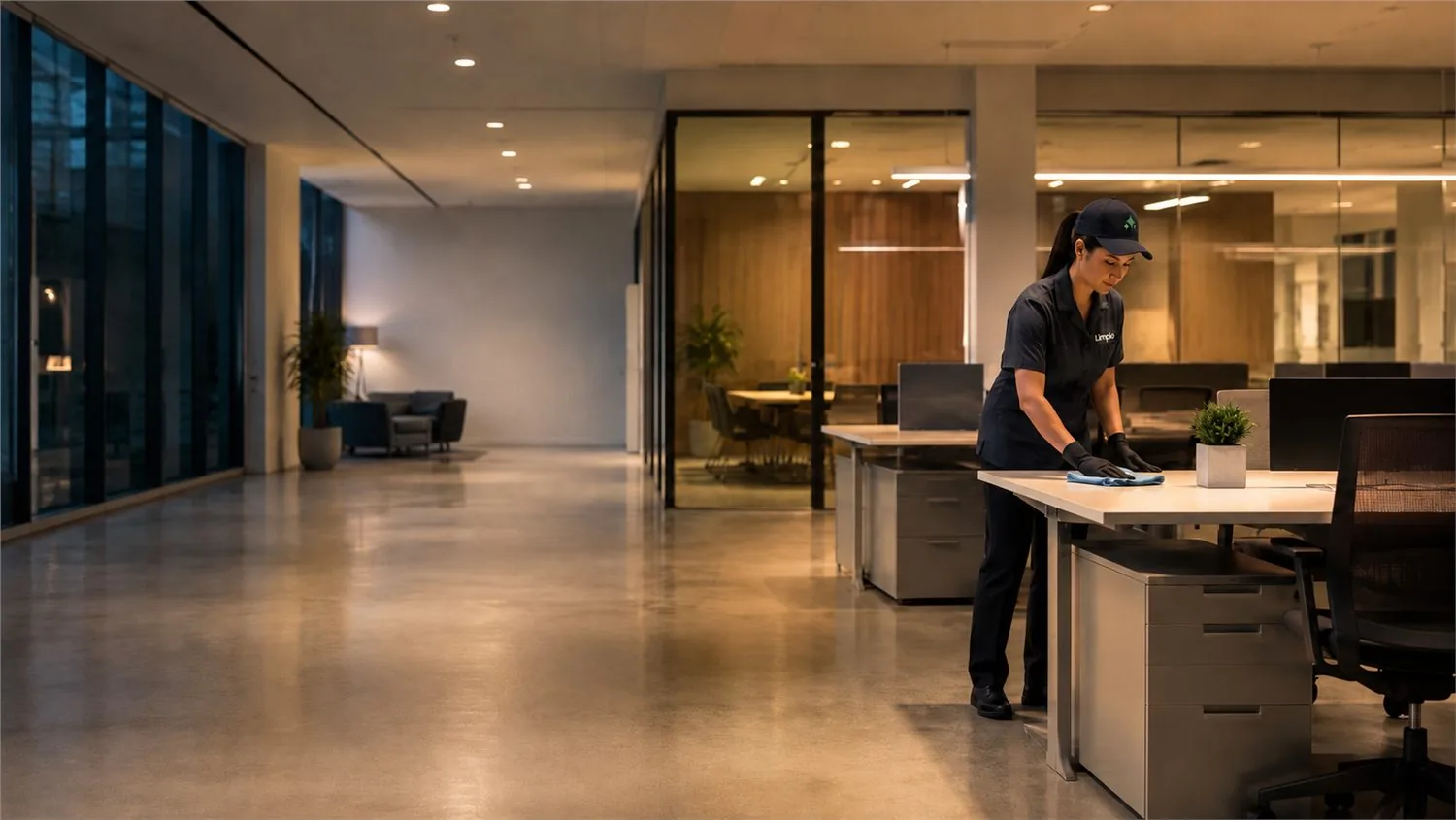
This question almost never comes up when things are going well. It comes up after a complaint about a restroom at two in the afternoon, or after a client waited in a lobby that had clearly been cleaned twelve hours earlier and had been lived in since.
The two options solve different problems, and picking the wrong one is expensive in a quiet way: you keep paying for a service that was never designed to fix what is actually bothering you. Here is what each one really covers, and the five things that decide it.
What a day porter actually does
A day porter works while your building is occupied. Depending on the size of the space that means either someone on site for a block of hours, or scheduled rounds through the day. The work is reactive by design.
- Restrooms checked and restocked at peak hours rather than once at midnight
- Entries and lobbies kept clear, which in a Minneapolis winter means salt, slush and wet matting
- Break rooms reset after the lunch rush instead of at the end of the day
- Spills, overflowing bins and anything else that cannot wait until tonight
- Meeting rooms turned over between bookings
The value of a day porter is not extra cleaning. It is that the building never visibly degrades during the hours people are in it. You are buying presence, and presence is priced by the hour whether or not something goes wrong.
What a night crew actually does
A night crew works in an empty building, usually between six in the evening and six in the morning. That changes the economics completely: nobody is at the desk you need to wipe, no meeting is happening in the room you need to vacuum, and a floor machine does not have to wait for foot traffic to clear.
- Full scope of work executed end to end without interruption
- Floor care that needs the surface free: extraction, scrubbing, refinishing
- Desks, common areas, restrooms and kitchens in one pass
- Trash and recycling out before the building opens
- Quality checks done against a written scope rather than on the fly
The same amount of work takes measurably fewer hours at night than during the day. That is the whole reason most commercial cleaning happens after hours, and it is why a night crew is almost always the cheaper way to buy a given scope.
The five things that actually decide it
Ignore the general advice and answer these five about your own building. The answers point to one option clearly more often than people expect.
1. Does the public see your space during business hours?
A clinic waiting room, a showroom, a coworking floor or a lobby with client meetings all degrade in front of the people you are trying to impress. An office where the only visitors are scheduled and rare does not. This one factor decides it more often than the other four combined.
2. What is your restroom load?
Count the people, then count the fixtures. A restroom serving forty people through a full day will run out of something before five o'clock no matter how well it was serviced at midnight. That is not a cleaning quality problem and no night crew can solve it.
3. When does your building actually get dirty?
Some spaces accumulate steadily and can be reset once. Others have a spike: a lunch rush, a shift change, a class letting out, a delivery bay at ten in the morning. A spike wants someone there for the spike.
4. Who can be in the building after hours?
Some tenants and some industries cannot have unaccompanied vendors overnight, or the building's access rules make it complicated. If after hours access is genuinely restricted, the decision is already made for you and the real question becomes how to make daytime work quietly.
5. What shape is your budget?
A night crew is a scope you buy: a defined set of tasks at a defined frequency. A day porter is time you buy: a block of hours whether or not something happens in them. Neither is better, but they behave differently when you need to trim, because you can reduce a frequency more easily than you can reduce a presence.
When each one wins
A night crew is enough when
- Your space is offices and meeting rooms with predictable, mostly internal traffic
- Restroom volume is comfortably handled by one service per day
- After hours access is straightforward
- You want the maximum scope of work per dollar
A day porter earns its cost when
- Clients, patients or the public are in your space during the day
- Restrooms or break rooms need midday attention to stay presentable
- Your building has a predictable daily spike
- Something visible going wrong at two in the afternoon is a real problem, not an inconvenience
The combination most buildings actually need
The framing as a choice between two options is mostly a sales convenience. What works for a lot of mid sized commercial buildings is a full night clean plus a short daytime round, usually two to four hours, covering only restrooms, entries and break rooms at the hours that matter.
That combination is often cheaper than a full day porter and noticeably better than nights alone, because you are paying for daytime presence only where daytime presence changes anything. If a vendor presents this as an either or, ask them to price the hybrid and compare the three.
What to ask before you decide
- Ask for the scope of work in writing for each option, task by task, not a summary paragraph
- Ask how many hours each option assumes. If they cannot tell you, they have not scoped it, they have guessed it
- Ask who specifically is on site, and whether it is the same person or crew week to week
- Ask what happens when something is missed, and get the answer in the service agreement rather than in an email
- Ask them to walk your building at the hour it is busiest, not at the hour that is convenient for them
A vendor who can answer those five without hedging is a vendor who has actually thought about your building. One who cannot is quoting from a template, and you will find out which in month three.
How Limpio handles it
Most of our accounts run on evening or early morning schedules, because for a typical office that buys the most scope for the money. Daytime service is available when your space is client facing and the standard has to hold while people are in it.
Either way the decision comes out of the walkthrough rather than out of a phone call, because it depends on things you can only see in the building: where the traffic lands, what the entry does in winter, and how the restrooms are actually used. You get the scope of work in writing before anything starts, and then you stop thinking about it.